
‘The Drumhead’: The Ultimate Cautionary Tale For Our Time
This TNG episode was the story we didn’t know in 1991 that we would someday need

One of Star Trek: The Next Generation’s best-remembered stories, “The Drumhead” was one of the franchise’s truly transcendent episodes.
It was one of those rare hours of television that became literature. Jeri Taylor’s story, Jonathan Frakes’ directing and superb performances all around — especially those by Patrick Stewart and guest star Jean Simmons as the retired admiral, Norah Satie — came together to rise to a level of excellence rarely seen even among the best of Star Trek.
Just watching it, you knew you were watching something really special. I certainly did, even the first time I saw it in 1991 during the original run of The Next Generation’s fourth season.
But even as I appreciated its exceptional quality and readily understood the point it was making about the fragility of due process and civil liberties, I always thought the “The Drumhead” was anachronistic, or at least, irrelevant for its time.
In the late 20th century, the moral of the story seemed to lack salience for the time.
They seemed more appropriate for a past era, the history of The Red Scare and McCarthyism.
Modern society was nowhere near perfect, of course, but the struggle seemed to be about increased access to rights rather than a serious concern about retrenchment and wholesale loss of those rights.
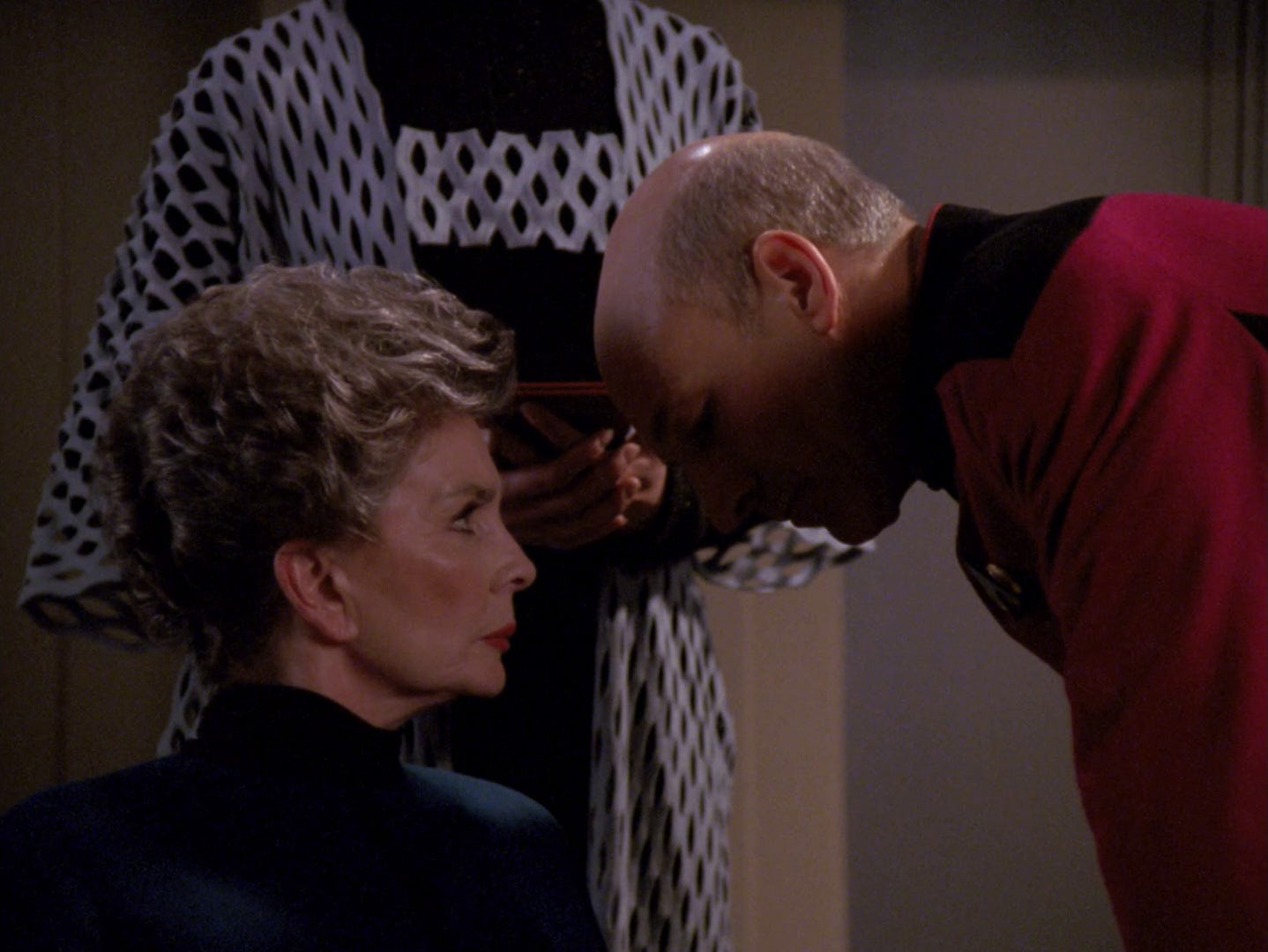
And yet, here we are, 35 years after its premiere and “The Drumhead” is more relevant than ever.
Satie’s conspiracy-driven investigation, hounding poor Simon Tarses (Spencer Garrett) and looking as she did for a widening net of scapegoats now seems like nothing more than prescient.
Please support my work…
People are disappeared from US streets by gangs of federal agents with absolutely no due process and US citizens are being shot and killed on street corners simply for exercising their constitutional rights to speech and protest.
And all the while the top officials of the US government make baseless claims and outright falsehoods that don’t even try to comport with the reality we see before us in the videos we watch about each of these atrocities.
Captain Picard’s riposte to an increasingly spiraling Satie sounds as though it could have been spoken about what we have witnessed over the last few months — if not the entire last year:
With the first link, the chain is forged. The first speech censured, the first thought forbidden, the first freedom denied, chains us all irrevocably.
And the final colloquy between Picard and Worf (Michael Dorn) that ends the episode — which seemed almost pedantic at the time — now seems to have been written for people like me who naively needed reminding that sometimes history really can tragically repeat itself:
PICARD: We think we've come so far. The torture of heretics, the burning of witches, it's all ancient history. Then, before you can blink an eye, it suddenly threatens to start all over again.
WORF: I believed her. I helped her. I did not see what she was.
PICARD: Mister Worf, villains who wear twirl their moustaches are easy to spot. Those who clothe themselves in good deeds are well camouflaged.
WORF: I think after yesterday, people will not be as ready to trust her.
PICARD: Maybe. But she, or someone like her, will always be with us, waiting for the right climate in which to flourish, spreading fear in the name of righteousness. Vigilance, Mister Worf, that is the price we have to continually pay.
Hailing Frequencies Open…
Here’s the latest that we’ve been keeping up with …
Paul Giamatti ‘Never’ Thought He’d Be Cast in New Star Trek Series: ‘A Top Experience for Me’ (Exclusive)
THE MAIN VIEWSCREEN
New ‘Star Trek’ Series Accused of Being “Woke” | The View
Enjoy this edition of Subspace Chatter?
Please make sure you …
And also …